

×
World Osteoporosis Day, observed annually on 20 October, raises awareness of osteoporosis and the importance of maintaining bone health throughout life. In 2026, the campaign focuses on the message “Build, Protect, Strengthen your bones for life,” highlighting the need to support skeletal health across different stages of life.
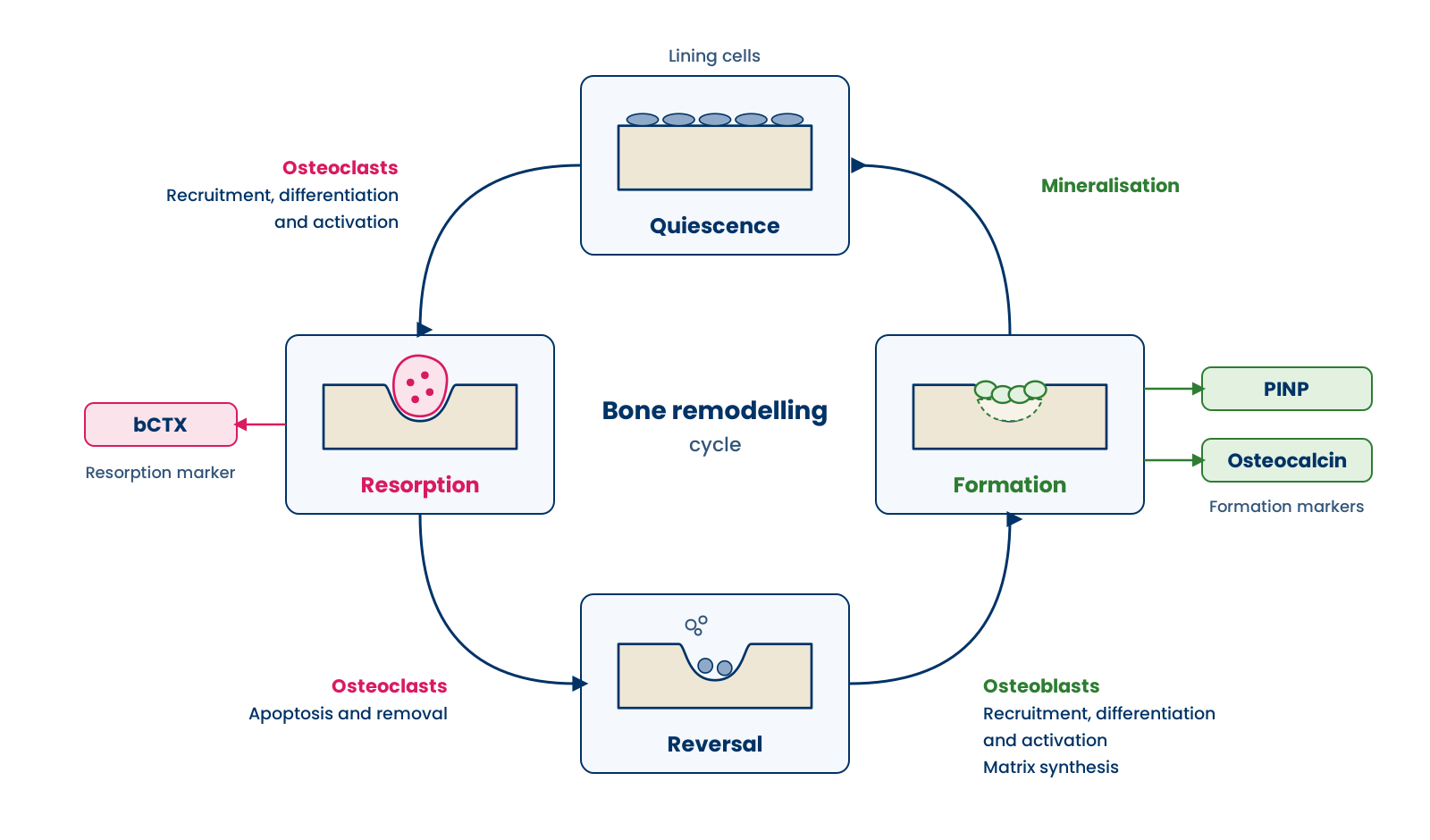
At the biological level, bone health is maintained through continuous remodelling, in which old bone is resorbed and replaced with newly formed bone. During bone resorption, osteoclasts break down the bone matrix, releasing degradation products of type I collagen such as beta-C-terminal telopeptide of type I collagen (bCTX). Bone formation then follows, as osteoblasts synthesise new bone matrix and release markers such as procollagen type I N-terminal propeptide (PINP) and osteocalcin.
These circulating bone turnover markers provide measurable information about the activity of bone resorption and formation. PINP and bCTX are internationally recommended reference markers for bone formation and bone resorption, respectively, while osteocalcin provides an additional marker of osteoblast activity and bone formation. Together, these markers offer complementary insights into changes in bone metabolism associated with ageing, menopause, osteoporosis and treatment response.
Reliable measurement of bone turnover markers depends on well-characterised reagents that support sensitive and robust immunoassay development. Hytest offers a portfolio of antibodies and antigens for key markers of bone formation and bone resorption, including PINP, bCTX and osteocalcin.
For PINP, Hytest provides monoclonal antibodies (MAbs, Cat. #4PIA7) for the development of total PINP immunoassays, together with recombinant human PINP antigen (Cat. #8PIN7) for assay development, calibration and control applications. In internal evaluations using a CLIA platform, all recommended antibody pairs achieved a limit of detection (LoD) of 5 ng/mL or lower. Among them, the W543–W509 pair also demonstrated strong correlation with the Roche Elecsys total PINP assay (R² = 0.9864).
For bCTX, Hytest offers MAbs (Cat. #4BT1) targeting human bCTX for the development of bone resorption assays. Cross-reactivity studies showed low to negligible reactivity with α-CTX across the antibody panel. The performance of the MAbs and recommended pairs was evaluated in an in-house chemiluminescent sandwich immunoassay, with the CX50–CX21 pair demonstrating the highest analytical sensitivity and an LoD of 11.3 pg/mL in EDTA-plasma sample.
For osteocalcin assay development, Hytest recommends osteocalcin MAbs from Cat. #4OC8, with different antibody combinations available depending on the intended assay design. The 2H9cc–6F9cc and 3G7–6F9cc pairs can be used to detect both intact human osteocalcin and its large N-terminal fragment, while the 3G8–2H9cc pair is recommended for assays specifically targeting intact human osteocalcin. These options allow assay developers to select antibody combinations according to the osteocalcin forms they intend to measure.
Bone metabolism extends beyond the processes of formation and resorption and is influenced by a wider network of hormonal regulation. Reflecting this broader biology, Hytest also provides reagents for calcitonin (Cat. #4C10), a hormone involved in calcium homeostasis and the regulation of osteoclast-mediated bone resorption.
On World Osteoporosis Day 2026, we are proud to support bone metabolism research and assay development with well-characterised antibodies, antigens and recommended antibody combinations across key markers of bone turnover and its regulation.
For further information, including product Datasheets, please visit the Hytest Bone Metabolism product range.
For details, please contact the Hytest North America Sales team.



Copyright © Hytest Ltd.