

×
COVID-19 no longer follows a single, predictable global peak season. Although respiratory infections often increase during colder months, SARS-CoV-2 continues to circulate year-round, with activity rising at different times across countries and regions.
In many Northern Hemisphere countries, COVID-19 activity tends to increase during winter. However, analyses from the United States have also identified recurring peaks in late summer, typically between July and September. The World Health Organization notes that COVID-19 activity may peak several times a year, often driven by emerging variants and waning population immunity.
BA.3.2 “Cicada” Attracts Global Attention
One SARS-CoV-2 variant receiving increased attention is BA.3.2, nicknamed “Cicada.” First identified in South Africa in November 2024, BA.3.2 was subsequently detected in several regions worldwide.
BA.3.2 is genetically distinct from many recently circulating lineages, and laboratory findings indicate enhanced immune escape. This suggests that antibodies generated by previous infection or vaccination may neutralize BA.3.2 less effectively than some other circulating variants. Diagnostic testing therefore remains important for identifying infections, monitoring transmission and supporting genomic surveillance.
Evaluating the Recognition of Emerging Variants BA.3.2
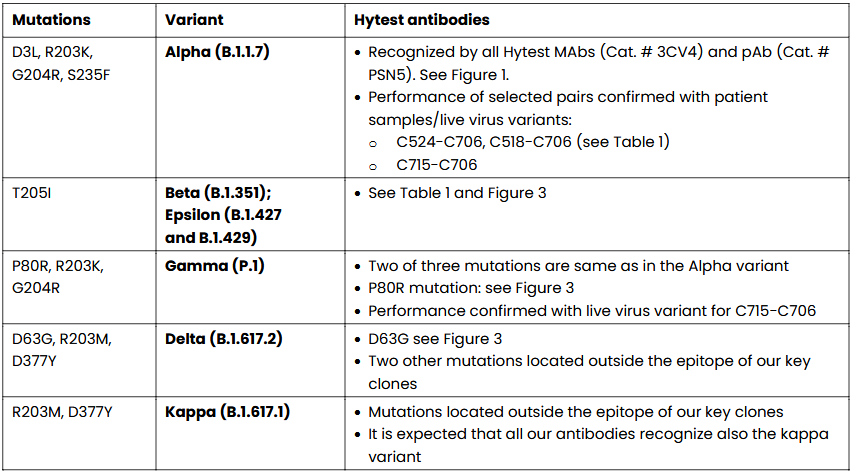
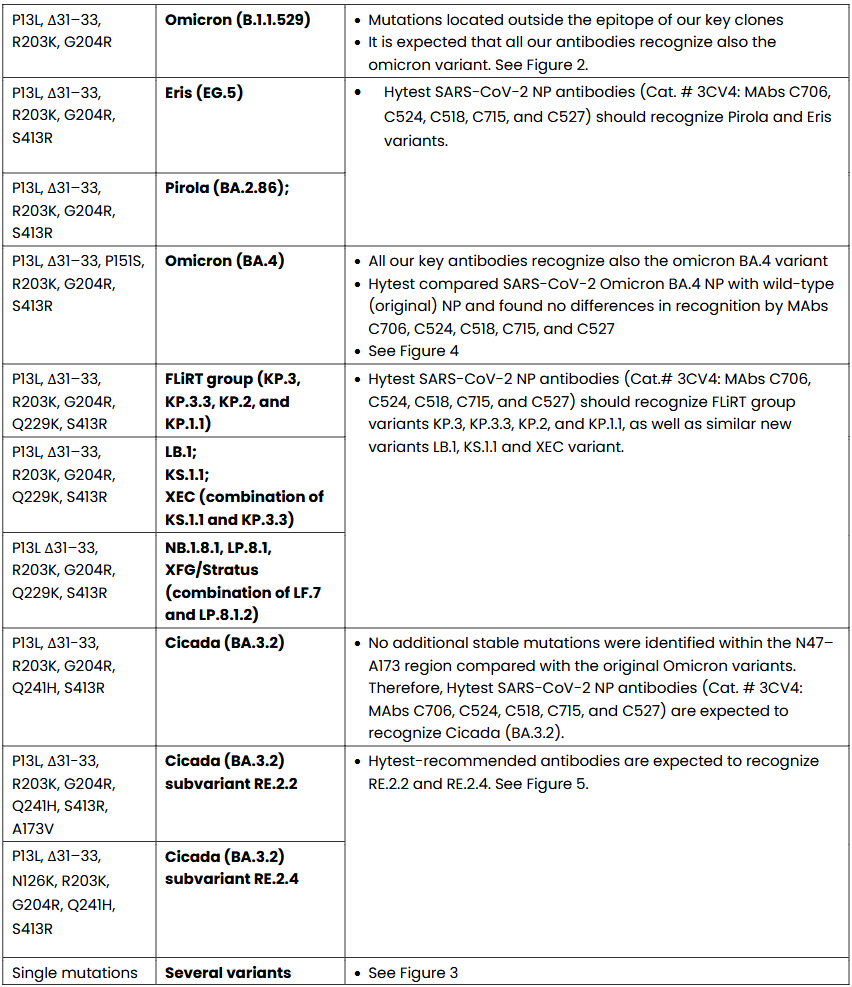
Based on sequence analysis, Hytest North America’s SARS-CoV-2 NP MAbs (Cat. # 3CV4 MAbs C706, C524, C518, C715 and C527) are expected to recognize the BA.3.2 (Cicada) variant.
Our scientists also analysed the NP sequences of the BA.3.2 subvariants RE.2.2 and RE.2.4. To evaluate antibody recognition, they engineered an NP mutant containing the N126K and A173V substitutions associated with these two subvariants. The substitutions were introduced into the Omicron NP gene, and the resulting mutant was tested with all recommended Hytest anti-SARS-CoV-2 NP MAbs.
The results demonstrated that the tested Hytest MAb sandwich pairs successfully detected the engineered NP mutant representing the changes identified in RE.2.2 and RE.2.4.
Broad Recognition of SARS-CoV-2 Variants
In addition to BA.3.2 and its subvariants RE.2.2 and RE.2.4, Hytest’s SARS-CoV-2 NP MAbs are expected to recognize a broad range of important variants. These include Pirola and Eris variants; FLiRT-group variants KP.3, KP.3.3, KP.2, and KP.1.1; LB.1; KS.1.1; XEC (combination of KS.1.1 and KP.3.3); as well as newer variants NB.1.8.1, LP.8.1 and XFG/Stratus (combination of LF.7 and LP.8.1.2).
Detection of SARS-CoV-2 virus variants tested with two recommended pair combinations on lateral flow. Swab samples were used as specimen. Note that line intensity depends on virus load that can vary between samples. The results show that these two pairs detect all three virus variants in lateral flow. Source: Customer data kindly provided with permission to show.
For further information, explore our SARS-CoV-2 products and marketing material:
To support SARS-CoV-2 research, assay development and diagnostic applications, explore our recombinant antigens, monoclonal antibodies and polyclonal antibodies for COVID-19 detection and variant monitoring:
For more information, contact Hytest North America.



Copyright © Hytest Ltd.